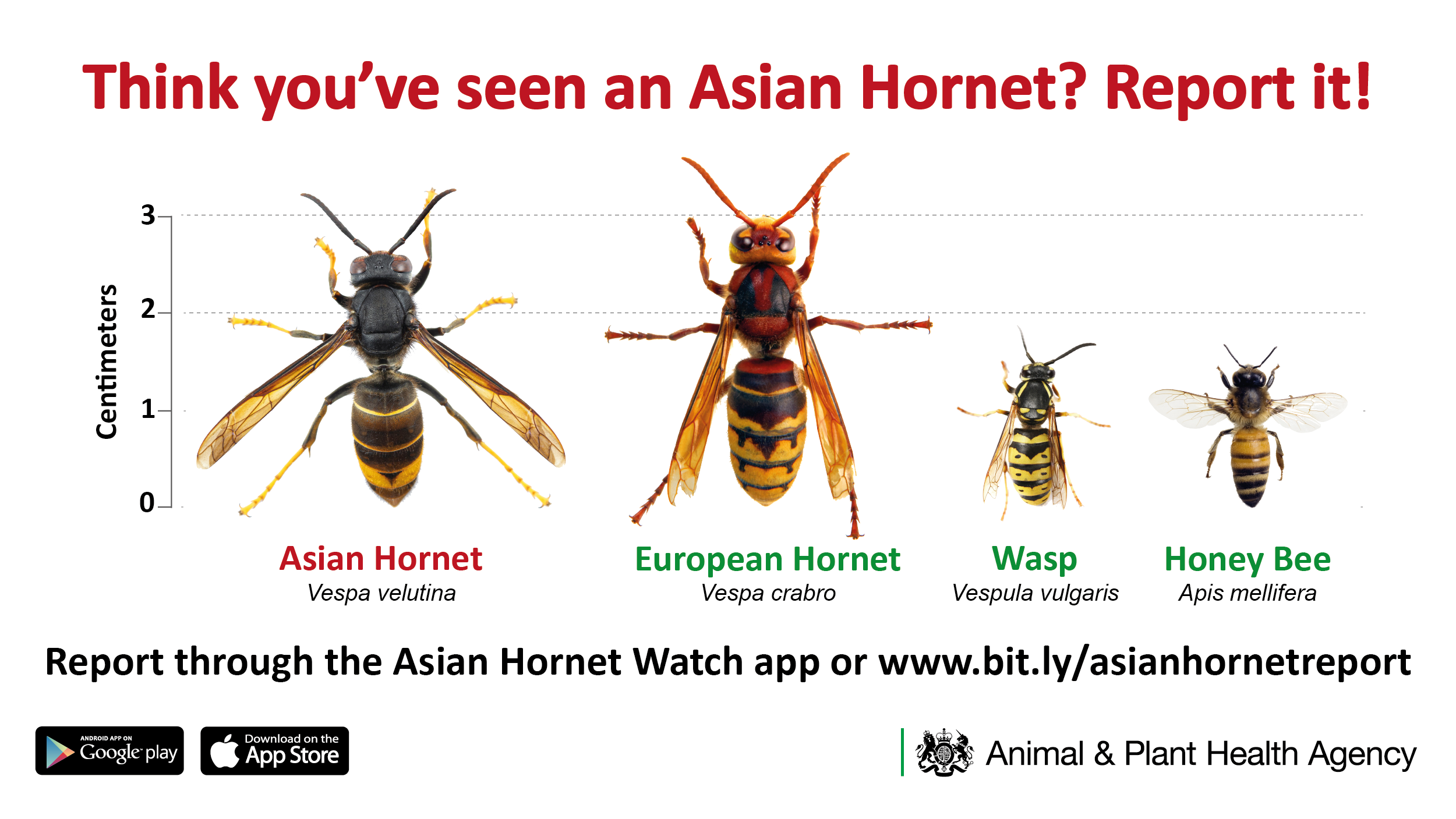
Asian hornet
Yellow-legged (Asian) hornet

Native to Asia, the yellow-legged hornet was first spotted in Europe in France in 2004 and has spread rapidly across different countries in Europe since.
Threat to our natural environment
The hornet has seen increasing reports of sightings in the UK over recent years, and has now been confirmed in Leicestershire. This wasp is a highly effective predator of insects and poses a big threat to honeybees and other important pollinators as well as other beneficial species.
To manage and help eliminate this threat to our natural environment, it is important that sightings of the predatory wasp are reported.
Is the Asian hornet a threat to people?
Asian hornets are usually not aggressive towards people, but will be if they perceive a threat to their nest. Therefore, it is important never to disturb an active nest.
Identifying a yellow-legged hornet
Tips to help identify the insect:
- It's significantly smaller than the native hornet
- Legs are yellow at the ends
- In general, it appears dark brown or black and velvety
- It has a dark brown/black abdomen with a yellow/orange band on fourth segment
- It has a black head with an orange/yellow face
For further tips on identifying the insect, please view:
- Non-native species secretariat (NNSS)’ yellow-legged hornet fact sheet (nonnativespecies.org)
- Wasp and bee comparison sheet (nationalbeeunit.com)
Identifying a nest
Many wasps and hornets, including yellow-legged hornet, produce two types of nest: primary nests and secondary nests. All wasp and hornet nests look similar. To identify a nest, watch for insects from a safe distance.
Yellow-legged hornet primary nests:
- Spherical with a small entrance hole at the base, usually 5cm to 10cm in diameter
- Built-in spring by a lone yellow-legged hornet queen, usually in a protected place such as brambles, a hedgerow, or in/on a building. Only report primary nests if seen with yellow-legged hornets
Yellow-legged hornet secondary nests:
- Pear-shaped, entrance hole halfway up the nest, up to 60cm wide and 80cm tall
- Usually found in trees, may also be in buildings and hedges
- Use binoculars to identify secondary nests from a safe distance. Do not disturb suspected nests and retreat from any wasp/hornet nests if flying insects are observed
For more information, please see the Asian hornet nest identification sheet (nonnativespecies.org)
What to do if you see a yellow-legged hornet
It is important not to disturb an active nest. If you see an Asian hornet or its nest, please take a photo of it (if possible) and report it via any of the below options:
- With the app:
- Online via non-native species alert (brc.ac.uk)
- Via email to alertnonnative@ceh.ac.uk
There is no need to contact the council directly.
Further information
More information and the latest about sightings can be found at Asian hornet: UK sightings (GOV.UK)
The photograph used in this page is from NNSS (nonnativespecies.org) and by Q. Rome.
Last updated: 14/05/2026 10:00